

How To Draw A Plant Cell Wall
Constitute cells are the basic unit and building blocks of life in organisms of the kingdom Plantae. They are cells that take a distinct nucleus and other cellular organelles enclosed within a membrane and thus are eukaryotic in origin.
A model of a typical plant jail cell is plant to be rectangular in shape, ranging in size from 10 to 100 µm. Nether the microscope, information technology shows many different parts. Each part, known as an organelle, works together to keep the cell functional.
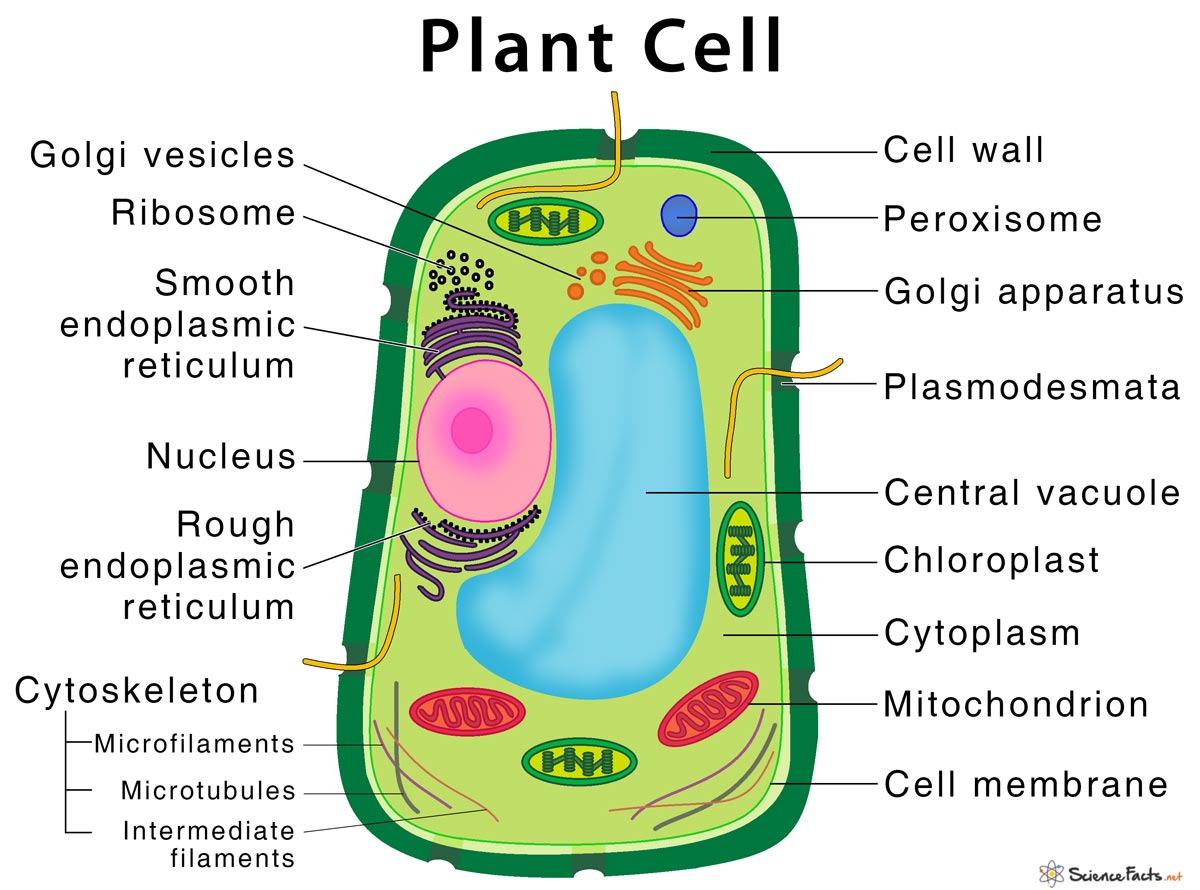
1) Jail cell Wall
It is the outermost, protective layer of a plant jail cell having a thickness of 20-80 nm. Cell walls are made upward of carbohydrates such as cellulose, hemicellulose, and pectin and a complex organic polymer called lignin.
Functions
- Providing mechanical strength, support, and rigidity to the cell
- Providing shape to the plant
- Assuasive selective entry of small molecules inside the cell while preventing big molecules
- Protecting the delicate inner organelles from outer daze
- Providing turgidity to plants that allows movement of water and minerals throughout the plant torso
2) Plastids
They are double membrane-leap organelles that have their ain genetic material. Plastids are mainly of iii types:
a) Chloroplasts: Found in the greenish parts of a plant and algae that comprise the photosynthetic pigment, chlorophyll.
b) Leucoplasts: Institute in the not-photosynthetic tissues of plants.
c) Chromoplasts: Colored plastics found in fruits and flowers of plants. Chromoplasts normally have red, orange, and yellow-colored pigments.
Functions
- Absorbing low-cal energy (Chloroplast)
- Converting light free energy into chemic free energy to produce food in the class of carbohydrate by a procedure chosen photosynthesis (Chloroplast)
- Providing defense against infections (Chloroplast)
- Helping in the production of high energy phosphate molecules, ATP (Chloroplast)
- Storing of protein, lipid, and starch (Leucoplasts)
- Synthesizing and storing colored pigments (Chromoplast)
3) Central Vacuole
Information technology is the large vesicle that make up almost xxx to 80% of the total institute jail cell volume. The central vacuole is oft the largest organelle in the jail cell that is filled with fluid, ions, enzymes, and other molecules. Apart from plants, they are besides nowadays in algae.
Functions
- Maintaining turgidity of the jail cell that prevents plants from wilting
- Storing of reserve food, water, and waste matter materials of the cell
- Breaking of macromolecules into simpler ones using specific enzymes present inside them
4) Jail cell Membrane or Plasma Membrane
It is a thin, biological membrane having a thickness of 7.5-ten nm that separates the interior of the cell from the outside environment. The plasma membrane is selectively permeable in nature, which is mainly composed of lipids and proteins, with some carbohydrates fastened to them.
Functions
- Protecting the cell from the outside environment and thus providing additional structural support
- Maintaining the shape of the cell
- Regulating the entry and leave of nutrients, essential minerals, and toxic waste material products within the cell
- Helping in the formation of tissues
- Helping in cellular communication
- Regulating cell growth
5) Endoplasmic Reticulum (ER)
It is a series of membranes within the cytoplasm that forms connections with the nucleus on i side and cell membrane on the other. It is of two types: rough endoplasmic reticulum (RER) and smooth endoplasmic reticulum (SER). The surface of RER has ribosomes attached to it, while they are absent-minded in SER.
Functions
- Helping in the germination of nuclear membrane during cell division
- Producing trans-membrane proteins, lipids, glycogen and other steroids like cholesterol for its membrane and other parts of the cell
- Packaging and transporting of proteins and carbohydrates to other organelles
- Providing an increased surface surface area for cellular interactions
- Forming the skeletal framework of the cell
6) Golgi Apparatus
Also known as Golgi body or Golgi complex, they are stacks of v to eight membrane-covered sacs chosen cisternae. The Golgi apparatus acts every bit the post office of the cell by packaging and transporting proteins from their source RER to their destination.The number of Golgi apparatus varies in cells co-ordinate to their functions.
Functions
- Synthesizing circuitous polysaccharides of the jail cell wall
- Processing, packaging. transporting, and secretion of the proteins produced in the crude endoplasmic reticulum
- Performing protein modifications such equally phosphorylation and glycosylation
- Breaking down of proteins into simpler ones
7) Microfilaments or Actin Filament
They are a network of long and thin protein fibers present in the cytoplasm of the prison cell having a diameter of iii-half dozen nm. Microfilaments are equanimous of actin proteins that make them extremely stiff and flexible.
Functions
- Helping in the contraction of muscles
- Helping in cell movement
- Aiding in cell division
- Maintaining cell shape
- Helping in the menstruum of cytoplasmic contents including nutrients within the jail cell (cytoplasmic streaming)
8) Microtubules
They are fibrous hollow rods composed of proteins called tubulin. Microtubules take an outer diameter of 23-27 nm and an inner diameter of most 11-xv nm. They can grow to equally long as 50 µm and thus are highly dynamic.
Functions
- Maintaining the structure of the cell
- Helping in cell movement
- Participating in jail cell segmentation
- Helping in the movement of cell organelles and nutrients within the cell (cytoplasmic streaming)
- Helping in cellular communication
nine) Intermediate Filaments
They are fabricated upwards of ii proteins forming a coiled-coil structure. Intermediate filaments have a diameter of eight-10 nm that are intermediate in size to microfilaments and microtubules. Microtubules, together with microfilaments and intermediate filaments, form the cytoskeleton of the prison cell.
Functions
- Maintaining the structural integrity of the jail cell
- Maintaining cell shape
- Helping in the movement of prison cell organelles and nutrients within the jail cell (cytoplasmic streaming)
10) Mitochondria
Information technology is a rod-shaped double membrane-bound organelle that contains its own DNA and ribosomes. Mitochondria are often chosen the 'powerhouse of the cell', producing ATP that drives all cell-based metabolic activities.
Functions
- Producing the energy currency of the cell, the ATP
- Helping in cellular respiration, which involves breaking downward of nutrients to generate energy
- They maintain the concentration of Ca2+ within the cell past working closely with the endoplasmic reticulum
11) Nucleus
Information technology is a spherical shaped double membrane-bound organelle that contains the genetic fabric of the prison cell, the Dna. A nucleus has four master parts:
Nuclear membrane or Nuclear envelope: A double-layered membrane that separates the nucleus from the prison cell cytoplasm.
Chromatin threads or Chromosomes: Genetic material of the cell that takes part in jail cell division
Nuclear sap or Nucleoplasm: Clear, homogeneous, and transparent liquid that contains the genetic textile of the cell along with proteins, sugars, and enzymes.
Nucleolus: Membrane-less region where ribosome is manufactured
Functions
- Storing the genetic material of the cell
- Controlling jail cell growth and reproduction
- Decision-making and analogous center of the cell
- Transmitting genetic information to the next generation
12) Peroxisomes
They are single membrane-bound organelles with a diameter of 0.1-1 mm that houses a wide diverseness of digestive and oxidative enzymes. They vary widely in shape, size, and number depending upon the free energy requirement of the cell.
Functions
- Performing oxygen-dependent breakup of substrates such as fat acids and glycerol
- Helping in the recycling of carbon, during prison cell metabolism
xiii) Ribosomes
They are particles that either remains fastened to the endoplasmic reticulum or are found freely suspended in the cytoplasm. Ribosomes are the protein-synthesizing center of the cell.
Functions
- Synthesizing proteins required for all cellular activities including growth and reproduction
14) Cytoplasm
It is the semifluid substance that fills up the entire infinite of the cell and is enclosed by the cell membrane. The portion of the cytoplasm that is not enclosed by prison cell organelles is chosen the cytosol. The cytoplasm is mainly composed of h2o, salts, and proteins.
Functions
- Maintaining turgidity and thus helps in keeping jail cell shape
- Assisting several metabolic activities such equally prison cell division, respiration and breaking downwards of waste products
- Keeping the cell organelles in their positions
- Providing the raw materials necessary for the chemic reactions within the cell
15) Plasmodesmata
They are minor channels that form connections between the cytoplasm of adjacent establish cells. Plasmodesmata are formed through a close clan between the plasma membrane and the endoplasmic reticulum of the cell.
Functions
- Allowing motility of water, nutrients and pocket-size signaling molecules between neighboring cells
- Transfering viral genomes betwixt cells
- Helping in the cellular advice
Parenchyma cells: Living cells that are capable of division. Parenchyma cells in plants perform photosynthesis and aid in gas exchange. They also shop reserve food materials such as starch and proteins.
Collenchyma cells: Elongated cells with thick degradation of cellulose in their cell walls. Collenchyma provides support to growing parts of a plant.
Sclerenchyma cells: Dead cells that have very thick jail cell walls. Sclerenchyma cells provide mechanical back up to the plant.
Xylem cells: Hard, h2o-conducting cells that help to send h2o and nutrients absorbed by the roots to all parts of the institute.
Phloem cells: Cells that distribute food and sap, mainly in the form of sucrose from the leaves to all parts of the plant.
Q1. Which organelles are unique to plant cells?
Ans. The iii organelles found but in a plant cell are cell wall, chloroplast, and central vacuole.

Source: https://www.sciencefacts.net/plant-cell.html
Posted by: stameypursee.blogspot.com
0 Response to "How To Draw A Plant Cell Wall"
Post a Comment